
Stop trusting one AI.
Ask the Council.
One AI gives you an answer. SearchCouncil gives you a verdict.
Ask ChatGPT, Claude, Gemini, Perplexity, Grok, Qwen, DeepSeek, GLM, and Kimi, and other leading AI models at once. SearchCouncil compares their answers, shows where they agree or split, and turns the results into one clear Council Verdict.
So you do not have to wonder which AI to trust.
30 free credits every month. No credit card required.
Ask the Council:


'%3e%3c/path%3e%3cpath%20d='M20.616%2010.835a14.147%2014.147%200%2001-4.45-3.001%2014.111%2014.111%200%2001-3.678-6.452.503.503%200%2000-.975%200%2014.134%2014.134%200%2001-3.679%206.452%2014.155%2014.155%200%2001-4.45%203.001c-.65.28-1.318.505-2.002.678a.502.502%200%20000%20.975c.684.172%201.35.397%202.002.677a14.147%2014.147%200%20014.45%203.001%2014.112%2014.112%200%20013.679%206.453.502.502%200%2000.975%200c.172-.685.397-1.351.677-2.003a14.145%2014.145%200%20013.001-4.45%2014.113%2014.113%200%20016.453-3.678.503.503%200%20000-.975%2013.245%2013.245%200%2001-2.003-.678z'%20fill='url(%23lobe-icons-gemini-1-_R_0_)'%3e%3c/path%3e%3cpath%20d='M20.616%2010.835a14.147%2014.147%200%2001-4.45-3.001%2014.111%2014.111%200%2001-3.678-6.452.503.503%200%2000-.975%200%2014.134%2014.134%200%2001-3.679%206.452%2014.155%2014.155%200%2001-4.45%203.001c-.65.28-1.318.505-2.002.678a.502.502%200%20000%20.975c.684.172%201.35.397%202.002.677a14.147%2014.147%200%20014.45%203.001%2014.112%2014.112%200%20013.679%206.453.502.502%200%2000.975%200c.172-.685.397-1.351.677-2.003a14.145%2014.145%200%20013.001-4.45%2014.113%2014.113%200%20016.453-3.678.503.503%200%20000-.975%2013.245%2013.245%200%2001-2.003-.678z'%20fill='url(%23lobe-icons-gemini-2-_R_0_)'%3e%3c/path%3e%3cdefs%3e%3clinearGradient%20gradientUnits='userSpaceOnUse'%20id='lobe-icons-gemini-0-_R_0_'%20x1='7'%20x2='11'%20y1='15.5'%20y2='12'%3e%3cstop%20stop-color='%2308B962'%3e%3c/stop%3e%3cstop%20offset='1'%20stop-color='%2308B962'%20stop-opacity='0'%3e%3c/stop%3e%3c/linearGradient%3e%3clinearGradient%20gradientUnits='userSpaceOnUse'%20id='lobe-icons-gemini-1-_R_0_'%20x1='8'%20x2='11.5'%20y1='5.5'%20y2='11'%3e%3cstop%20stop-color='%23F94543'%3e%3c/stop%3e%3cstop%20offset='1'%20stop-color='%23F94543'%20stop-opacity='0'%3e%3c/stop%3e%3c/linearGradient%3e%3clinearGradient%20gradientUnits='userSpaceOnUse'%20id='lobe-icons-gemini-2-_R_0_'%20x1='3.5'%20x2='17.5'%20y1='13.5'%20y2='12'%3e%3cstop%20stop-color='%23FABC12'%3e%3c/stop%3e%3cstop%20offset='.46'%20stop-color='%23FABC12'%20stop-opacity='0'%3e%3c/stop%3e%3c/linearGradient%3e%3c/defs%3e%3c/svg%3e)


'%20fill-rule='nonzero'%3e%3c/path%3e%3cdefs%3e%3clinearGradient%20id='lobe-icons-qwen-_R_0_'%20x1='0%25'%20x2='100%25'%20y1='0%25'%20y2='0%25'%3e%3cstop%20offset='0%25'%20stop-color='%236336E7'%20stop-opacity='.84'%3e%3c/stop%3e%3cstop%20offset='100%25'%20stop-color='%236F69F7'%20stop-opacity='.84'%3e%3c/stop%3e%3c/linearGradient%3e%3c/defs%3e%3c/svg%3e)

'%20fill-rule='evenodd'%3e%3c/path%3e%3c/svg%3e)

Your question
Should we acquire BrightLedger for $18M if revenue is growing 42% YoY, but churn doubled from 7% to 14%?
Council Consensus
5 of 6 AIs agree
The Verdict
Do not acquire at $18M under the current conditions. The growth is attractive, but the churn spike may destroy the valuation case. Pause the deal, investigate whether churn is monthly or annual, and renegotiate only if the churn is annual, explainable, and fixable.
What the Council caught
Growth was the obvious signal. Churn was the hidden risk.
The AI Council
Built for answers you need to trust
Most AI tools give you one confident response.
That works for casual questions. It does not work when the answer affects money, strategy, credibility, legal risk, health conversations, client recommendations, or business decisions.
SearchCouncil changes the workflow.
Instead of asking one chatbot and hoping it is right, you ask a council of leading AI models. Each model answers independently. SearchCouncil compares the responses, scores consensus, flags disagreement, surfaces blind spots, and writes one Council Verdict.
When the AIs agree, you get a stronger signal. When they disagree, you know exactly where to look closer.
That is the point of the Council.
Live Examples
See what the Council catches that one AI misses
Business risk, legal gaps, architecture tradeoffs, medical uncertainty, financial exposure, research quality — same workflow, different stakes.
SearchCouncil is especially useful when a question has more than one reasonable answer, hidden assumptions, missing facts, or real consequences.
Example categories
- Acquisition Risk
- Contract Risk
- Architecture Decision
- Business Risk
- Legal Interpretation
- Medical Research
- Financial Due Diligence
- Academic Review
- Product Strategy
- Content Fact-Checking
Business Risk
Your question
Should we acquire BrightLedger for $18M if revenue is growing 42% year over year, but churn increased from 7% to 14%?
Council Consensus
5 of 6 AIs agree
Council Verdict
Do not acquire BrightLedger for $18M under the current conditions. The Council agrees that 42% year-over-year revenue growth is attractive, but the doubling of churn from 7% to 14% is a major red flag that undermines the company’s sustainability, customer lifetime value, and valuation. The biggest unresolved issue is whether the 14% churn is monthly or annual. If it is monthly, the deal may be fundamentally broken. If it is annual and fixable, the Council recommends pausing the acquisition, running deeper due diligence, and renegotiating the price significantly lower.
What the Council caught
The models agreed that growth alone is not enough. High churn may mean new revenue is simply replacing lost customers rather than creating durable expansion. The Council also flagged missing due diligence around:
- Whether churn is monthly or annual
- Root cause of churn increase
- ARR and revenue quality
- CAC and payback period
- Customer lifetime value
- Net revenue retention
- Customer concentration
- Logo churn vs. revenue churn
- Whether churn is isolated or systemic
- Whether the product still has strong market fit
Recommended next move
Pause the acquisition. Investigate why churn doubled, clarify whether the churn rate is monthly or annual, evaluate NRR and CLV, and only reconsider the deal if the churn is annual, explainable, and fixable. If the root cause points to weak product-market fit, walk away.
Why one AI is not enough
One model can sound right and still miss something
Single AI answers are fluent. That is the problem. They can sound complete even when they are missing context, edge cases, sources, risks, or better alternatives.
Multiple subscriptions get expensive fast
Using ChatGPT, Claude, Gemini, Perplexity, Grok, and other tools separately can mean multiple subscriptions, multiple tabs, and a lot of wasted time. SearchCouncil gives you multi-AI comparison from one place.
Manual comparison wastes time
Without SearchCouncil, you have to copy the same prompt into different tools, read every answer, compare the reasoning, and synthesize the result yourself. SearchCouncil does that workflow for you.
Agreement should be visible
If several models independently reach the same conclusion, that matters. If they split, that matters too. SearchCouncil makes the agreement pattern part of the answer — and surfaces perspective signals when models lean differently.
See where the AIs agree — and where they lean differently.
SearchCouncil does not just compare answers. It shows agreement, disagreement, missing context, source differences, and perspective signals across leading AI models.
Explore the Perspective IndexWhat SearchCouncil does
One question in. Multiple independent answers. Agreement scored. Disagreements flagged. One clear verdict out.
Ask once
Submit one question. SearchCouncil sends it to multiple leading AI engines based on the Council depth you choose.
Compare every answer
Each model responds independently, so you can see different reasoning, assumptions, and recommendations side by side.
Surface disagreement
SearchCouncil flags conflicts, weak spots, missing context, and model-specific blind spots.
Generate the Council Verdict
A Judge synthesizes the responses into one clear result with confidence, reasoning, caveats, and next steps.
Share the result
Create a view-only link so teammates, clients, or collaborators can review the full Council Verdict without rerunning the search.
Disagreement is not a bug. It is the signal.
Most AI products try to hide uncertainty. SearchCouncil shows it.
If ChatGPT says one CRM is best, Claude recommends another, and Perplexity adds recent sourced context, the disagreement is not noise. It tells you the question depends on criteria that need to be made explicit.
The Council helps you find the real decision underneath the prompt.
Multi-AI access vs. a real Council
| Capability | Multi-AI Switcher | SearchCouncil |
|---|---|---|
| Access multiple models | Yes | Yes |
| Ask one question across many AIs | Sometimes | Yes |
| Compare agreement | No | Yes |
| Flag disagreement | No | Yes |
| Generate one verdict | No | Yes |
| Show model-by-model reasoning | Limited | Yes |
| Share a finished result | Limited | Yes |
| Control depth and cost | Limited | Yes |
| Built for trust, not just chat | No | Yes |
A model switcher gives you access. SearchCouncil gives you judgment.
Killer feature
Analyze deeply. Read briefly.
For important questions, you want deep analysis. But you do not always want to read thousands of words.
SearchCouncil lets you run a deeper backend synthesis while keeping the front-end verdict short, clear, and usable.
You get the safety of deeper analysis without the bloat.
Deep synthesis
The judge reviews agreement, disagreement, blind spots, confidence, and evidence quality.
Brief verdict
You get the answer up front in plain language, without a wall of text.
Evidence when needed
The Consensus tab keeps the deeper reasoning available when the stakes require it.
Council modes
Five ways to run the Council
SearchCouncil has five modes. Pick the one that fits your question — from a single-engine direct ask to a full parallel council or a two-model convergence volley.
Direct
One engine — fastest path to an answer.
Pick one model. It answers your question, then SearchCouncil synthesizes a brief verdict. Best when you want a quick, low-cost answer without convening the full council.
Council
Every model answers. Judge synthesizes.
Each council member answers your question independently at the same time. The judge compares all answers and writes one Council Verdict. Best when you want maximum coverage and independent perspectives.
Sequential
Fast — pass the answer to the next
One council member answers first, then passes that answer to the next member in order. When every seat has contributed, the judge synthesizes a Council Verdict. Best when you want a lighter, faster run.
Convergence
Two AIs challenge and refine each other
Pick two engines. One answers, the other challenges it, they revise and check for agreement — then SearchCouncil produces a verdict classified as consensus, qualified consensus, or persistent split. Best when you want depth without a noisy multi-model debate.
Research
Many questions. Many councils. One final verdict.
Break a big topic into sub-questions. Each question runs through the council — every model answers, the judge synthesizes a verdict per question. Then a final verdict draws on all of those findings.
Deep Research
Sequential research for questions too big for one council run
Deep Research is for due diligence, market scans, strategy prep, and any topic that needs multiple angles investigated in order.
- 1
Set your main question
Describe what you need to understand — risks, competitors, regulations, positioning, or any multi-part research topic.
- 2
Plan staged sub-questions
SearchCouncil suggests focused research questions with AI, or you add and reorder your own. Each step targets one angle.
- 3
Run the council on each step
Each sub-question runs through the council — every model answers, the judge synthesizes a verdict for that question, and the next step begins.
- 4
Get a final verdict
The judge synthesizes all per-question verdicts into one final verdict: executive summary, key findings, agreement signals, blind spots, and recommended next steps.
Council depth
Choose the right Council depth
Not every question needs the same amount of AI.
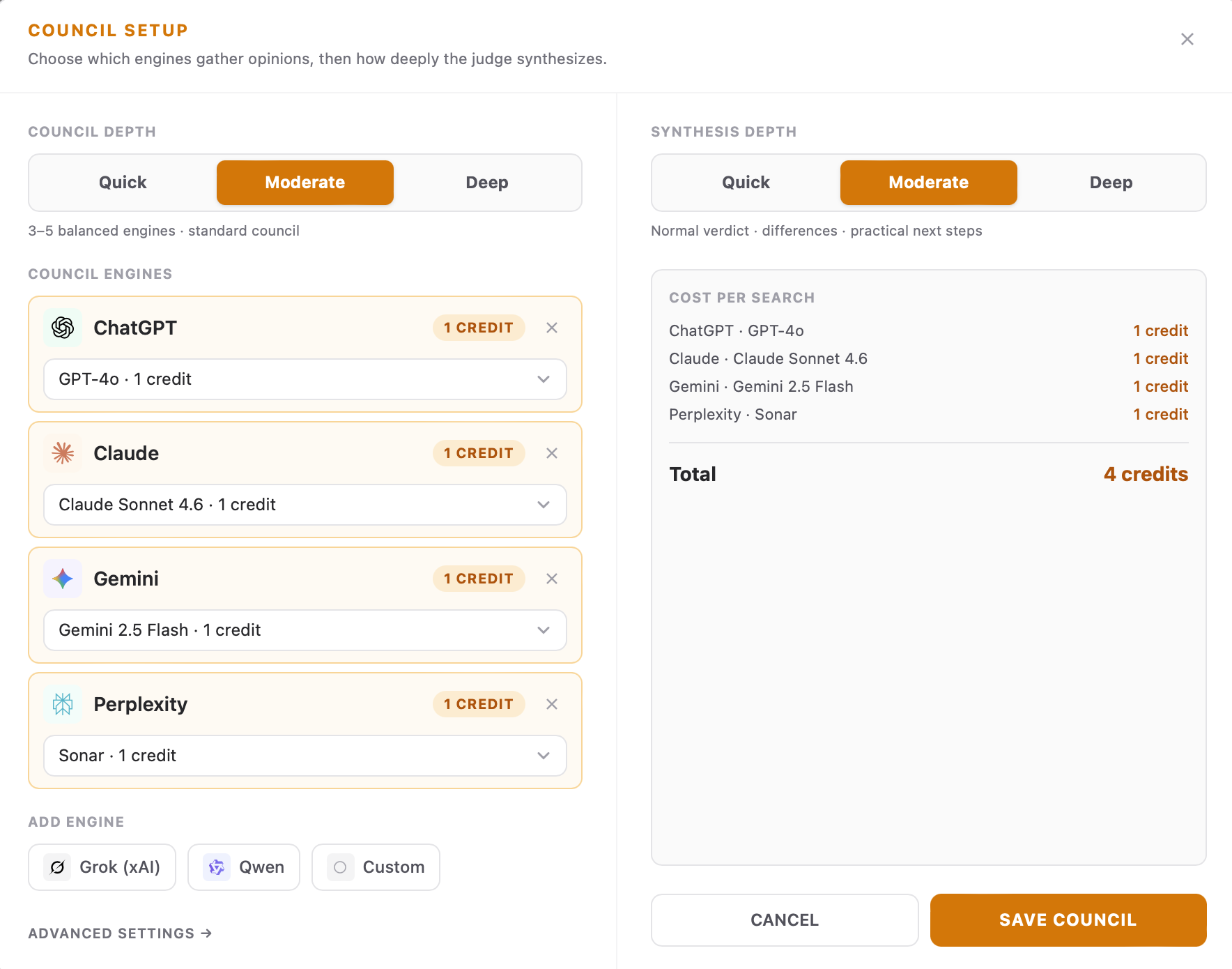
Moderate Council
Best for business decisions, client work, vendor comparisons, and research support.
Typical use
- “ What is the best CRM for a small agency?”
- “ Which competitor claim is strongest?”
- “ What should we recommend to a client?”
Typical search: ~4 credits
Synthesis depth
Choose how hard the judge works
Synthesis depth is separate from council depth. Council depth controls how many models answer. Synthesis depth controls how detailed the judge write-up is.
Quick Synthesis
Consensus · major disagreement
Best when you want a short, direct answer. You get the strongest shared answer, major disagreement (if any), and a simple next step.
Moderate Synthesis
Agreement · disagreement · unsupported claims · recommendation
Best for a balanced verdict. You get main consensus points, meaningful differences, risky or uncertain claims, a practical recommendation, and suggested next steps.
Deep Synthesis
Claim audit · contradiction map · blind spots · confidence
Best for more rigorous review. You get consensus points, a contradiction map, claim audit, confidence score, missing context, blind spots, excluded weak claims, and a stronger final recommendation.
Run a deep council with a quick answer, or a quick council with a more careful synthesis.
Use cases
Built for people who cannot afford to be confidently wrong
Consultants
Turn a client question into a multi-model verified brief. See where the AIs agree, where they split, and what you should say with confidence.
Founders and operators
Pressure-test strategy, positioning, hiring plans, pricing, product decisions, and investor narratives before you act.
Marketers and product teams
Compare claims, evaluate messaging, test positioning, review competitor pages, and get a clearer answer before building around one AI’s opinion.
Researchers and analysts
Run a question through multiple reasoning engines and use disagreement to identify what needs deeper review.
Legal and compliance prep
Surface competing interpretations, missing caveats, and areas where language may be risky before sending something forward.
Medical patients and advocates
Compare explanations and consensus points so you can ask better questions in a conversation with a qualified medical professional.

Engine answers
Every council member answers on its own
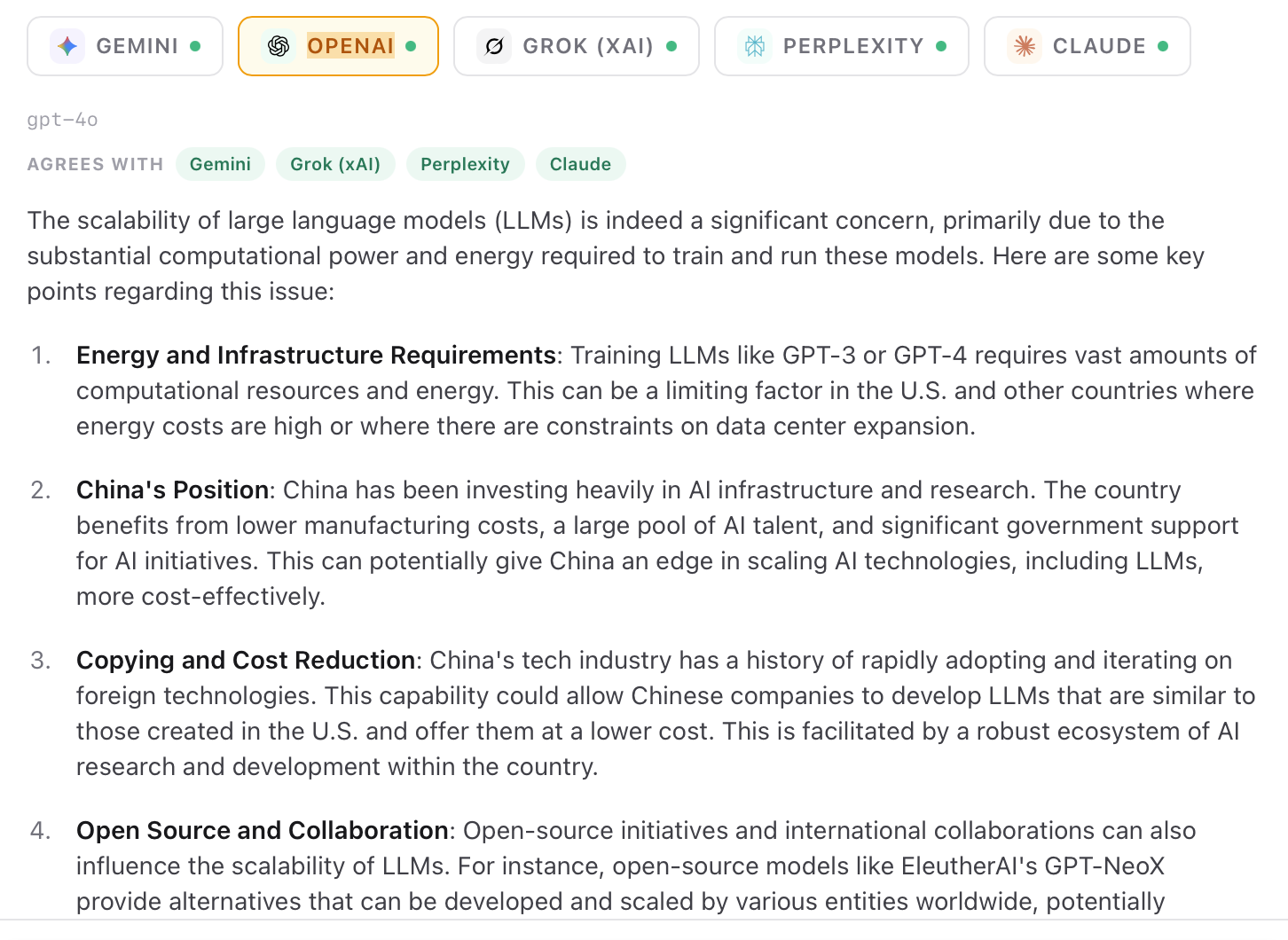
SearchCouncil doesn’t hide the individual responses. Switch between engines to read each full answer, see agreement signals, and compare reasoning before you trust the verdict.
Read ChatGPT’s full reasoning — model, agreement signals, and sources included.
Consensus
See how the verdict was judged — not just the answer
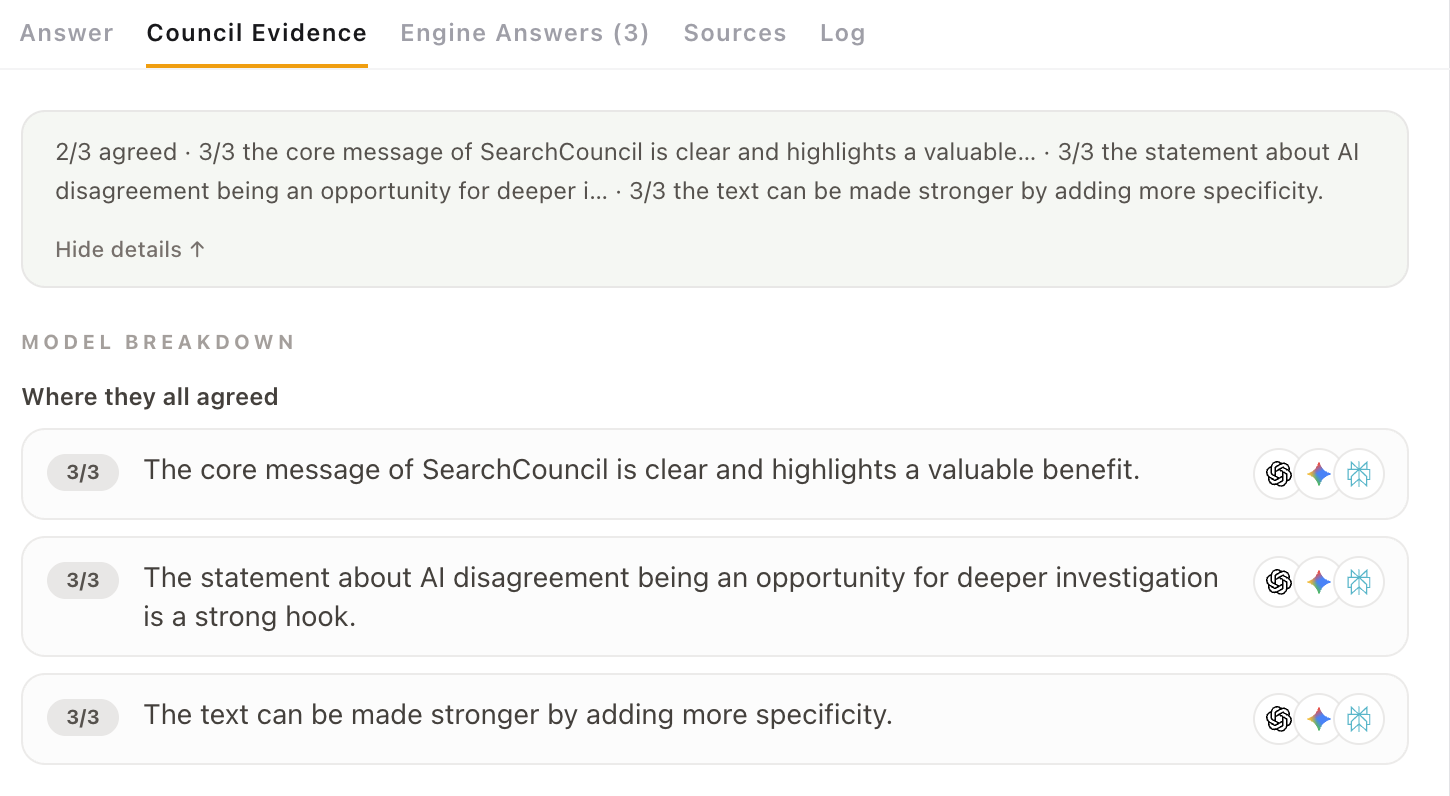
Every Council Verdict comes with a Consensus tab: agreement signals, model-by-model breakdowns, model differences, blind spots, and synthesis confidence — so you know what to trust.
See which claims every model supported — with a per-engine breakdown and agreement counts like 3/3.
The SearchCouncil workspace
Everything stays organized.
Projects
Group related searches by client, company, case, research topic, or decision.
Threads
Keep every Council run in context so you can revisit the full reasoning trail.
Engine answers
Read the individual responses from ChatGPT, Claude, Gemini, Perplexity, Grok, Qwen, DeepSeek, GLM, and Kimi, and other supported models.
Council Verdict
Get one synthesized answer with confidence, agreement, disagreement, and next steps.
Consensus
See the judge’s reasoning: common ground, model differences, blind spots, evidence quality, and confidence.
Share links
Send a view-only result to anyone who needs to review the answer.
Deep Research
Break a big topic into staged sub-questions, run the council on each step in order, and get a synthesized Research Brief.
Share & collaborate
Send the council verdict to anyone who needs to see it
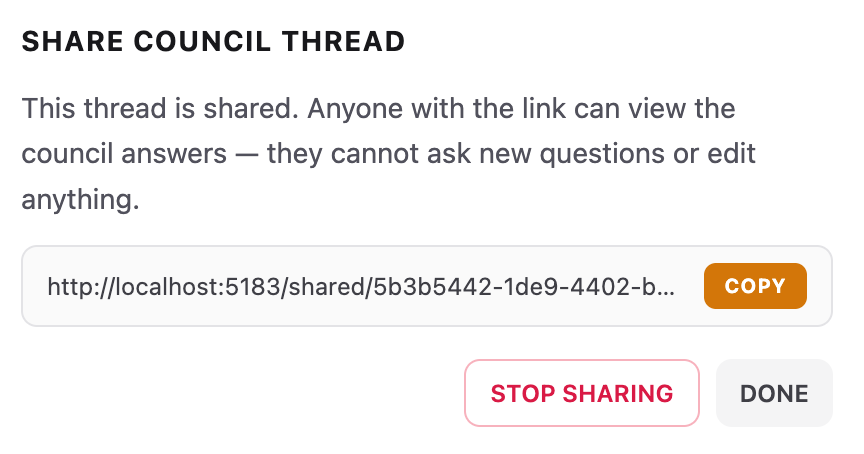
Share a view-only link to any thread. Teammates, clients, and collaborators can read every engine answer, the Council Verdict, and Consensus — without rerunning the search or pasting screenshots into Slack.
- ✓ One click to create a share link — copy and send
- ✓ Viewers don’t need an account to read a shared thread
- ✓ View-only: no edits, no new questions on shared links
- ✓ Stop sharing anytime — the link stops working immediately
What makes SearchCouncil different
Judgment, not just another chatbot
It is not another chatbot
SearchCouncil is an answer judgment engine. The product is not the chat. The product is the comparison, confidence, and verdict.
It is not just a multi-model dropdown
You are not switching between models manually. You are asking a structured Council and getting a synthesized result.
It is not a black box
You can see the individual answers, the agreement pattern, the disagreement, and the evidence behind the final verdict.
It is not built for endless reading
SearchCouncil does the heavy analysis behind the scenes, then gives you a short answer up front.
It is not priced like five AI subscriptions
Use included credits, buy extra credits, or bring your own API keys.
Pricing
Pay for the depth you need
SearchCouncil gives you control over cost. Use a lighter Council for quick questions. Use a deeper Council for important decisions. Use BYOK if you already have API keys.
Included credits
Start with free monthly credits so you can try the Council without a credit card — including agreement scoring and perspective signals on each run.
Credit packs
Buy more when you need deeper searches or higher volume.
BYOK
Bring your own OpenAI, Anthropic, Google, Fireworks, Qwen, DeepSeek, or other supported keys and use SearchCouncil for routing, comparison, history, and verdicts.
From the founder
“I built SearchCouncil because I got tired of copying and pasting answers between chatbots. The useful part was never just getting another AI response. The useful part was seeing where the models agreed, where they disagreed, and what that disagreement revealed. SearchCouncil turns that messy manual workflow into one simple product: ask once, compare the AIs, and get a verdict you can actually use.”
Privacy first
We treat your prompts, answers, uploaded files, API keys, and Council results as private user content. We do not sell them.
SearchCouncil is built for people and teams who need to ask serious questions without turning their work into someone else’s dataset.
The simple benefit
SearchCouncil asks multiple AIs, compares their answers, and synthesizes the results into one clear response.
You see where the models agree, where they disagree, what they missed, and how confident the final answer should be.
When the AIs agree, you get a stronger signal.
When they disagree, you get something even more valuable: a reason to look closer.
That is why the Council matters.
30 free credits every month. No credit card required.